
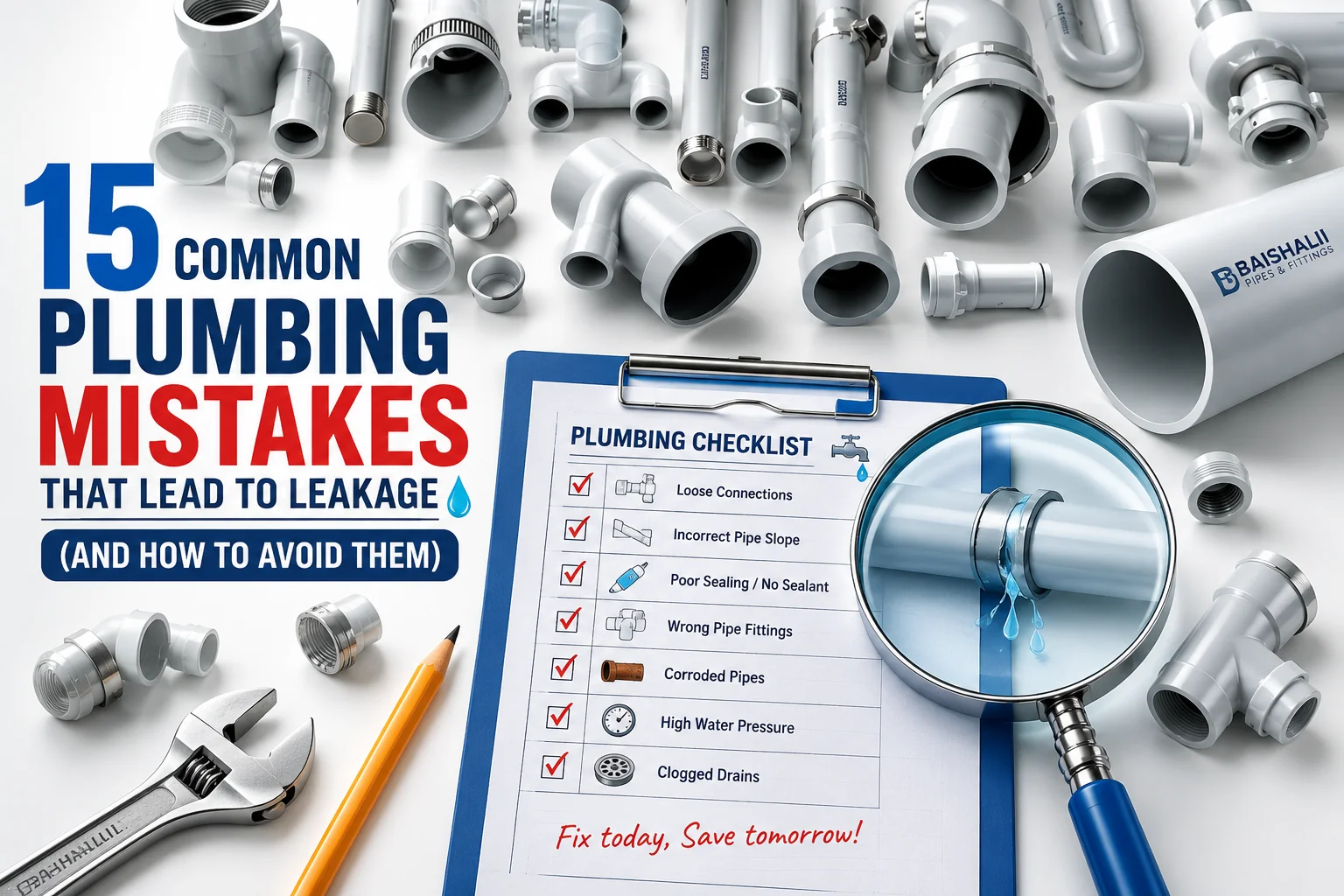
A dripping pipe rarely starts as a dripping pipe. Most leaks begin months or years earlier, as a small installation shortcut, the wrong fitting, or a joint that was never quite tightened properly. By the time water shows up on a wall or ceiling, the actual mistake is long buried behind tile or plaster.
This guide walks through the 15 plumbing mistakes that cause the vast majority of residential and commercial leaks — what causes each one, how to spot it early, and how to avoid it the next time you install or repair a pipe run.
Quick Summary
| # | Mistake | Most Common Result |
|---|---|---|
| 1 | Overtightening fittings | Cracked threads, hairline fractures |
| 2 | Undertightening fittings | Slow seepage at joints |
| 3 | Mixing incompatible pipe materials | Galvanic corrosion, poor seal |
| 4 | Using the wrong pipe grade/pressure rating | Bursts under pressure |
| 5 | Skipping or misapplying solvent cement | Weak, leak-prone joints |
| 6 | Poor pipe support/spacing | Sagging, stress fractures |
| 7 | Ignoring thermal expansion | Joint separation over time |
| 8 | Incorrect slope on drain lines | Standing water, back-pressure leaks |
| 9 | Reusing old fittings or washers | Premature seal failure |
| 10 | Not pressure-testing before closing walls | Hidden leaks discovered too late |
| 11 | Poor PTFE tape/thread sealant application | Weeping threads |
| 12 | Nailing or drilling through hidden pipe runs | Punctures |
| 13 | Ignoring water hammer | Repeated joint stress and failure |
| 14 | Corrosion from poor water quality | Pinhole leaks |
| 15 | DIY fixes without proper tools | Cascading damage |
1. Overtightening Fittings
More torque is not more security. Overtightening a compression fitting, union or threaded joint stresses the material past its design tolerance. In PVC and CPVC fittings especially, this often produces hairline cracks that don't leak immediately — they leak weeks later, once the pipe has been through a few heating and cooling cycles.
How to avoid it: Hand-tighten, then use a wrench for a maximum of one to one-and-a-quarter additional turns. If you're relying on brute force to stop a leak, the fitting or seal is the problem, not the torque.
2. Undertightening Fittings
The opposite mistake is just as common. A joint that's snug but not fully seated leaves a microscopic gap that won't show up during a quick visual check or even a short pressure test, but will seep once the system is under sustained daily pressure.
How to avoid it: Follow manufacturer torque specifications where available, and always do a static pressure test (see mistake #10) before considering a joint finished.
3. Mixing Incompatible Pipe Materials
Joining copper directly to certain metals without a dielectric union causes galvanic corrosion — a slow electrochemical reaction that eats through pipe walls from the inside. Mixing pipe materials without the correct transition fitting is one of the most underestimated causes of long-term leakage.
How to avoid it: Always use the transition fitting rated for the specific material pairing, and never assume "it fits" means "it's compatible."
4. Using the Wrong Pipe Grade or Pressure Rating
Not all PVC pipe is built for the same job. Casing pipe, agricultural pipe and pressure pipe are manufactured to different wall thickness and pressure ratings for a reason. Installing a lower-rated pipe on a high-pressure line is a leak (or burst) waiting to happen, especially as temperatures fluctuate seasonally.
How to avoid it: Match the pipe's ISI/pressure class to the actual operating pressure of the line, not just the nominal diameter. When in doubt, ask the manufacturer for the pressure rating documentation.
5. Skipping or Misapplying Solvent Cement on PVC Joints
Solvent-welded PVC and CPVC joints depend on a proper chemical fusion, not glue in the traditional sense. Common errors include not applying primer first, using too little cement, not rotating the pipe a quarter-turn on insertion, or not holding the joint long enough for initial set. Any of these leaves a joint that looks sealed but isn't fully fused.
How to avoid it: Always prime, apply cement to both the pipe and the fitting socket, insert with a quarter-turn, and hold for the manufacturer-specified set time before releasing pressure on the joint.
6. Poor Pipe Support and Spacing
Pipes that aren't supported at the correct intervals sag under their own weight and the weight of the water inside them. Over time, that sag concentrates stress at the nearest joint, and that joint is where the leak eventually appears.
How to avoid it: Follow standard support-spacing guidelines for the pipe material and diameter — typically every 90–120 cm for PVC pipe runs, tighter for larger diameters or hot water lines.
7. Ignoring Thermal Expansion
Pipe expands and contracts with temperature — plastic pipe more than metal. A long straight run installed without any allowance for movement will push and pull against its joints every single day. Eventually, that repeated micro-movement works a joint loose.
How to avoid it: Use expansion loops or offsets on long straight runs, and avoid rigidly anchoring pipe at both ends of a long span.
8. Incorrect Slope on Drain Lines
Drain and waste lines need to maintain a small slope, typically around a 2% grade. Too little slope and water sits in the pipe, causing back-pressure and increased load on joints below the waterline. Too much slope, and water outpaces solids, leading to residue buildup and eventual blockage — which also causes leaks at the nearest joint under pressure.
How to avoid it: Use a level and check slope at multiple points during installation.
9. Reusing Old Fittings, Washers or O-Rings
During a repair, it's tempting to reuse the fitting that "looks fine." Rubber washers and O-rings degrade with age and lose their compression memory — they may seal for a few days and then fail once they take a full compression set.
How to avoid it: Replace washers, O-rings and gaskets any time a joint is opened, even if the old part looks undamaged.
10. Skipping the Pressure Test Before Closing Walls
This is the single most expensive mistake on the list, because it turns every other mistake invisible until the wall or floor is already closed. A pressure test catches weak joints while they're still accessible and cheap to fix.
How to avoid it: Pressure-test the full line at 1.5× working pressure for at least 30 minutes before any tiling, plastering or backfilling.
11. Poor Application of PTFE Tape or Thread Sealant
Wrapping thread tape in the wrong direction (against the thread), using too few wraps, or skipping sealant on threaded metal fittings altogether all lead to the same result: threads that look connected but weep slowly under pressure.
How to avoid it: Wrap PTFE tape clockwise (in the direction of tightening), 3–4 wraps minimum, and use a compatible thread sealant for critical joints.
12. Nailing or Drilling Through Hidden Pipe Runs
A huge share of "mystery leaks" are actually punctures — a nail through a wall-mounted picture frame, a screw for a shelf bracket, a drilled anchor for a cabinet. The leak often doesn't appear immediately if the puncture is small; it shows up weeks later once corrosion or pressure widens the hole.
How to avoid it: Keep as-built plumbing diagrams for every wall with hidden runs, and use a pipe/stud detector before drilling in bathrooms, kitchens or utility walls.
13. Ignoring Water Hammer
That banging noise when a tap or valve closes quickly isn't cosmetic — it's a pressure spike slamming through the pipe network, and it repeats every time that valve is used. Over months, water hammer loosens joints and stresses fittings well beyond their static-pressure rating.
How to avoid it: Install water hammer arrestors near quick-closing valves (washing machines, dishwashers, solenoid valves), and check that pressure-reducing valves are correctly set.
14. Corrosion From Poor Water Quality
Highly acidic or highly mineralised water accelerates internal corrosion in metal pipe and can degrade certain fitting materials faster than expected. This shows up as pinhole leaks — small, easy-to-miss weeps that indicate a much larger internal corrosion problem.
How to avoid it: Test water quality (pH, hardness, chlorine levels) periodically, and select pipe and fitting materials rated for your local water chemistry.
15. DIY Fixes Without the Right Tools
A pipe wrench used in place of a proper pipe cutter, tape used to "hold" a fitting instead of replacing it, or a joint reassembled without the correct primer — these emergency fixes often outlast their intended lifespan of "until the plumber arrives" and quietly become permanent, weak points in the system.
How to avoid it: Treat quick fixes as temporary by design, and schedule a proper repair with the correct tools and materials as soon as possible.
The Common Thread
Almost every item on this list traces back to one of three root causes: the wrong material for the job, a joint that wasn't properly formed, or a system that was never pressure-tested before being sealed up. Catching any one of these early is dramatically cheaper than repairing water damage after the fact.
If you're sourcing pipe and fittings for a new installation or renovation, choosing ISI-certified pipe with the correct pressure rating for your application — and having it installed by someone familiar with proper jointing technique — solves most of this list before it ever becomes a problem.
Frequently Asked Questions
What is the most common cause of pipe leaks? Joint failure — either from improper solvent welding, overtightening or undertightening — is the single most common cause of leaks in both PVC and metal plumbing systems.
How often should plumbing be pressure-tested? Any new installation or repaired section should be pressure-tested before it's closed up behind walls or flooring. Existing systems benefit from a pressure check every few years, especially in older buildings.
Can a small leak get worse over time? Yes. A pinhole leak or weeping joint rarely stays small. Pressure, corrosion and water damage around the leak point typically widen it over time, which is why early detection matters.
Is PVC or metal pipe more prone to leaks? Neither is inherently more leak-prone when installed correctly. Most leaks in both materials come from installation errors rather than the material itself.
Explore the full BAISHALII pipe and fittings catalogue — from ISI-certified uPVC and CPVC to borewell casing and agri pressure pipes — on our Products page, or send us an enquiry and our team will help you spec the right line for the job.
Have a project in mind?
Talk to our team about pipes, tanks and fittings for your requirement.
Get in Touch