
From the BAISHALII team — PVC pipes & fittings
What Is a PVC Casing Pipe?
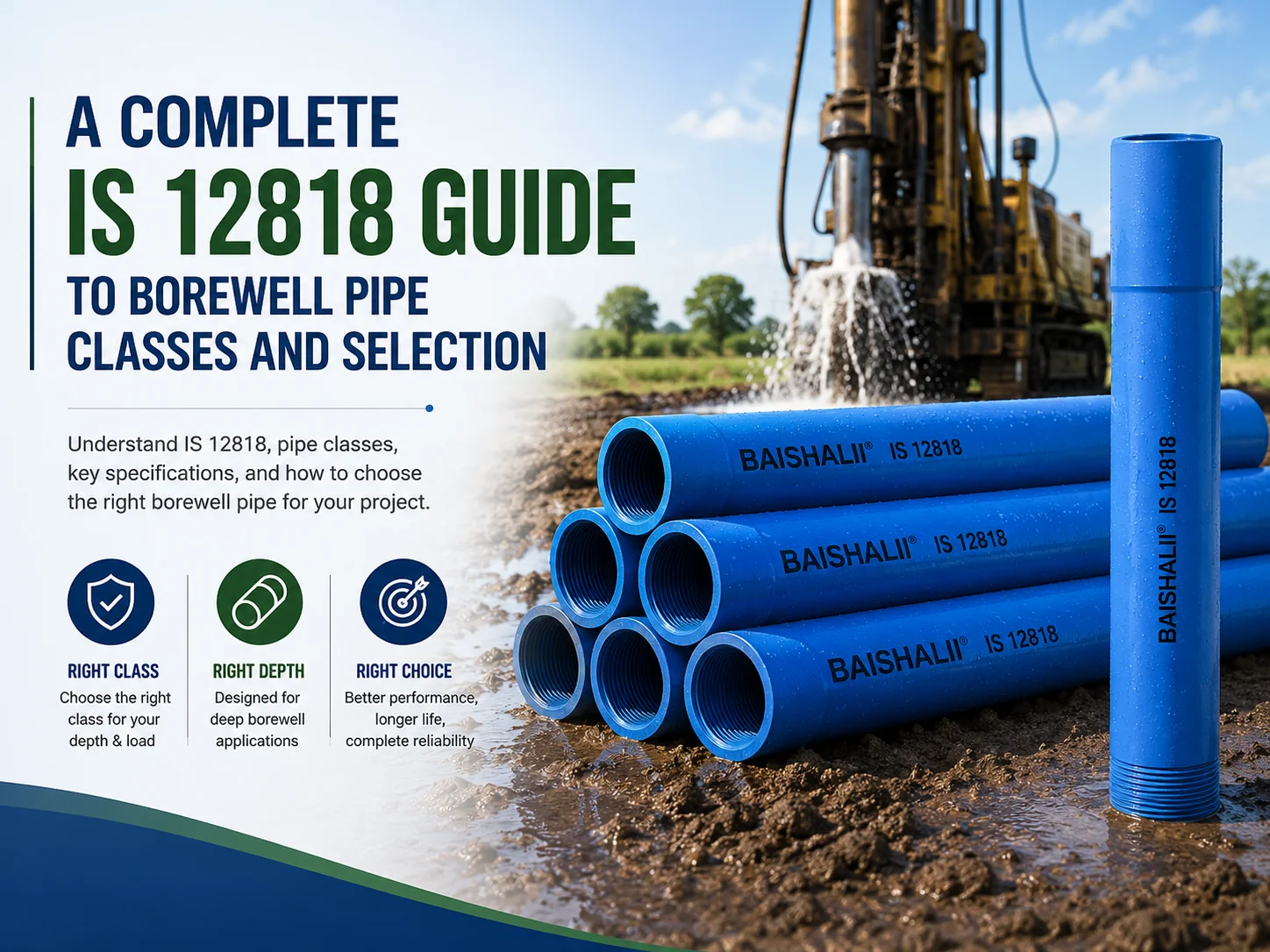
A PVC casing pipe is a rigid uPVC pipe lowered into a borewell or tube well to line the bore, prevent the surrounding soil or rock from collapsing into the hole, and protect the groundwater source from contamination. It is a structural component of the well itself — not a plumbing pipe — and its selection is driven by bore depth, soil formation, and pump load rather than by flow rate. BAISHALII BorePro is our casing and screen pipe range, manufactured to IS 12818 for exactly this application.
Why Casing Pipe Class Matters More Than Diameter
The single most common mistake in borewell casing selection is choosing pipe by diameter alone and treating class as an afterthought. Under IS 12818, casing pipe is categorised into three classes based on the depth and pressure conditions it's designed to withstand:
| Class | Full Form | Depth Range | Typical Use |
|---|---|---|---|
| CS | Casing Shallow | Up to 80 m | Domestic and light agricultural borewells in stable soil |
| CM | Casing Medium | 80 m – 250 m | Standard borewells for irrigation, commercial, and municipal use |
| CD | Casing Deep | 250 m – 450 m | Deep borewells, harsh soil conditions, higher hydrostatic collapse pressure |
Using a CS-class pipe below its depth rating risks pipe collapse under external hydraulic pressure during and after well construction — a failure that's expensive to diagnose and effectively impossible to repair once the pipe is set in the bore.
How BorePro Casing Pipes Are Jointed
BorePro casing pipes use threaded joints rather than solvent-weld or rubber-ring joints — one end male-threaded, the other a female-threaded socket, with V-type or trapezoidal thread profiles depending on class. This threaded system allows sections to be assembled and lowered progressively during drilling, which is standard practice for casing pipe and different from the socket/solvent jointing used in above-ground plumbing pipe. Protective caps are fitted on the threads for transit and storage so they arrive at the rig undamaged.
Plain Casing vs. Ribbed Screen Pipe
Borewell construction typically uses two pipe types together, not one:
- Plain casing pipe — solid-wall pipe used to line the bore through impermeable strata and as an extension above the screened section
- Ribbed/slotted screen pipe — the same class of pipe with slots cut into the wall, installed opposite the water-bearing aquifer to allow water in while filtering out sediment
Matching slot size to the aquifer's sediment characteristics is a site-specific decision usually made with the drilling contractor, since undersized slots restrict yield and oversized slots draw in sand.
Material and Manufacturing Standards
BorePro casing pipes are manufactured from unplasticised PVC (uPVC), non-toxic and safe for drinking water applications, in the standard deep blue used to visually distinguish casing pipe from pressure or drainage pipe on site. Key properties relevant to borewell use:
- Conforms to IS 12818 for dimensions, wall thickness, and mechanical performance
- Resistant to corrosion, electrolytic attack, and chemical encrustation from aggressive soil conditions — the primary long-term failure mode for metal casing
- Rated for hydrostatic collapse pressure appropriate to its class, to withstand external pressure during and after installation
- Manufactured and supplied in standard 3 m and 6 m lengths
Frequently Asked Questions
What is the difference between CS, CM, and CD casing pipe? They are IS 12818 depth-rated classes — CS for borewells up to 80 m, CM for 80–250 m, and CD for 250–450 m — with increasing wall thickness and collapse pressure rating at each level.
Can PVC casing pipe be used at any borewell depth? No. Class selection must match the actual bore depth and soil/pressure conditions; using an underrated class below its depth limit risks pipe collapse.
Why is casing pipe usually blue? Deep blue is the conventional colour for uPVC casing pipe in India, used to visually distinguish it on site from white/grey plumbing pipe and drainage pipe.
Do casing pipes use solvent-weld joints like plumbing pipe? No. Casing pipe uses threaded (male/female) joints so sections can be assembled and progressively lowered during drilling — a different jointing method from SWR or pressure pipe.
What's the difference between plain casing and screen pipe? Plain casing is solid-wall pipe used to line the bore; screen (slotted/ribbed) pipe has cut slots and is installed at the aquifer to let water in while filtering sediment.
Planning a Borewell Installation?
Our team can help match casing class, screen slot size, and quantity to your bore depth and soil report before drilling begins.
Have a project in mind?
Talk to our team about pipes, tanks and fittings for your requirement.
Get in Touch