
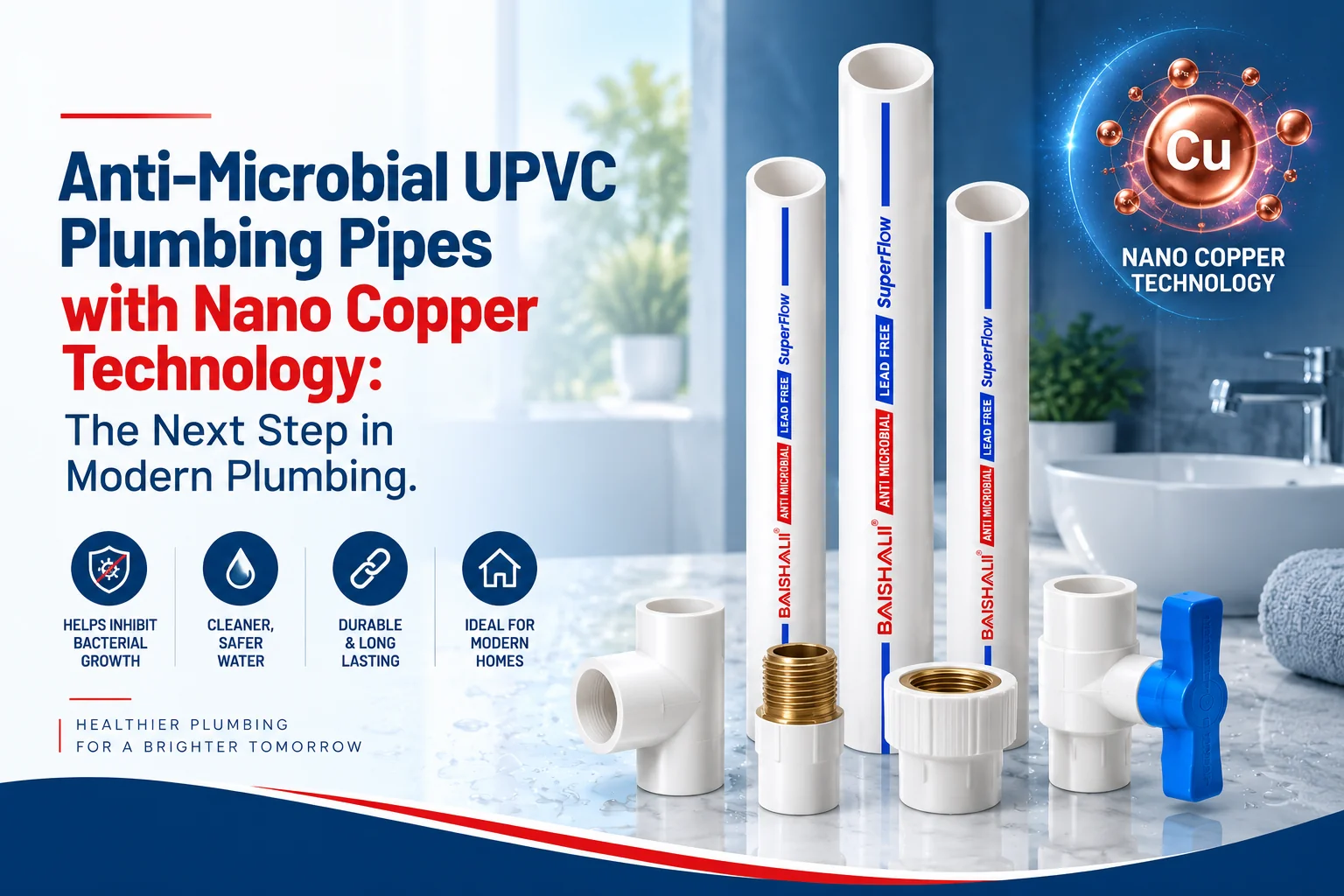
Plumbing systems are expected to do much more than simply carry water. They need to be durable, reliable, easy to install and capable of performing consistently for years.
Modern material technology is now adding another dimension to plumbing: hygiene-focused functionality.
One such innovation is Anti-Microbial Nano Copper Technology, incorporated into rigid UPVC plumbing pipes.
By combining the proven advantages of UPVC with copper-based antimicrobial technology, these advanced pipes are designed to provide an additional layer of protection against the growth or persistence of selected microorganisms under specified conditions.
But what exactly is nano copper technology, and what benefits can it bring to UPVC plumbing pipes?
Let's take a closer look.
What Are White UPVC Plumbing Pipes?
UPVC stands for Unplasticized Polyvinyl Chloride.
Unlike flexible PVC, UPVC is a rigid material that is widely used in plumbing and water distribution systems because of its combination of strength, chemical resistance, low weight and ease of installation.
White UPVC plumbing pipes are commonly used for applications such as:
- Cold-water plumbing
- Residential water distribution
- Commercial plumbing
- Building services
- Institutional plumbing
- Other pressurized-liquid applications, depending on the product specification
For pipes manufactured to ASTM D1785, the standard covers PVC plastic pipe in Schedule 40, Schedule 80 and Schedule 120 for the distribution of pressurized liquids. It specifies requirements and test methods covering areas such as dimensions, sustained pressure, burst pressure, flattening, extrusion quality, workmanship, finish, appearance and marking.
This provides the engineering foundation.
Anti-Microbial Nano Copper Technology adds another functional dimension.
What Is Anti-Microbial Nano Copper Technology?
Copper has been recognized for its antimicrobial properties for a very long time.
Modern research has shown that copper-based materials can interact with microorganisms through multiple mechanisms. These can include membrane damage, copper-ion interactions and oxidative damage.
In an anti-microbial UPVC pipe, nano copper technology refers to the controlled incorporation of a copper-based antimicrobial component into the pipe material or formulation.
The objective is simple:
To combine the structural and functional advantages of UPVC with an engineered antimicrobial property.
This is fundamentally different from simply adding a decorative coating to the outside of a pipe.
How Does Nano Copper Work?
The antimicrobial action of copper is complex and can vary depending on the microorganism and the material environment.
Copper can affect microorganisms through mechanisms such as:
- Interaction with cell membranes
- Release of copper ions
- Oxidative damage
- Disruption of cellular processes
- Damage to microbial genetic material
Copper nanoparticles can provide a large surface area for interaction, although actual antimicrobial performance depends on factors such as particle characteristics, concentration, formulation and test conditions.
This is why the performance of the finished UPVC pipe matters more than simply the presence of copper in the formulation.
Key Benefits of Anti-Microbial Nano Copper UPVC Pipes
1. Added Antimicrobial Functionality
The most obvious advantage is the addition of an antimicrobial feature to the pipe.
Depending on the formulation and testing, copper-based technology can help inhibit or reduce selected microorganisms under defined conditions.
This provides an additional hygiene-oriented characteristic that conventional UPVC pipes do not specifically target.
2. Hygiene-Focused Plumbing
Water passes through plumbing systems every day.
While conventional UPVC already provides a smooth and corrosion-resistant surface, incorporating antimicrobial technology is intended to make the pipe material itself more actively resistant to microbial colonisation.
This can be particularly relevant for modern plumbing systems where hygiene and material performance are considered together.
3. Combines Antimicrobial Technology with UPVC
The major advantage is that antimicrobial technology can be integrated with an established plumbing material.
UPVC offers several practical benefits, including:
- Lightweight construction
- Corrosion resistance
- Smooth internal surface
- Good chemical resistance
- Easy handling
- Convenient installation
- Low maintenance
Nano copper technology is intended to add an antimicrobial functionality to this existing material platform.
The result is a pipe designed around both performance and hygiene.
4. Potential for Long-Term Functional Performance
A plumbing pipe is expected to remain functional for many years.
Therefore, antimicrobial technology should ideally be engineered as part of the pipe formulation rather than treated simply as a temporary surface treatment.
However, claims of long-term antimicrobial performance should always be supported by appropriate testing of the finished product.
The important question is not simply:
"Does it contain nano copper?"
It is:
"Does the finished pipe demonstrate the claimed antimicrobial performance under relevant test conditions?"
Anti-Microbial Does Not Mean Water Purification
This distinction is extremely important.
An anti-microbial UPVC pipe should not automatically be described as a water purifier, disinfectant or sterilization system.
Antimicrobial functionality is intended to affect microorganisms associated with the tested material or surface under specified conditions. It does not mean that all microorganisms present in the water will be eliminated.
Water quality also depends on:
- Source-water quality
- Water treatment
- Storage tanks
- Plumbing hygiene
- Installation practices
- Environmental conditions
- Cross-contamination
Therefore:
Anti-microbial pipe technology should be viewed as an additional material feature, not a replacement for proper water treatment or sanitation.
Why ASTM D1785 Matters
Advanced technology is valuable only when it is built on a properly engineered pipe.
ASTM D1785 is the standard specification for Poly(Vinyl Chloride) (PVC) Plastic Pipe, Schedules 40, 80 and 120.
The specification addresses important aspects of pipe performance, including:
- Material classification
- Dimensions
- Workmanship
- Sustained pressure
- Burst pressure
- Flattening
- Extrusion quality
- Finish
- Appearance
- Marking
It also covers PVC pipe pressure-rated for water and other chemically compatible pressurized liquids.
This means antimicrobial functionality should be considered in addition to, rather than instead of, fundamental pipe engineering.
A premium pipe needs both.
Conventional UPVC vs Anti-Microbial Nano Copper UPVC
| Feature | Conventional UPVC | Anti-Microbial Nano Copper UPVC |
|---|---|---|
| UPVC construction | ✓ | ✓ |
| Lightweight | ✓ | ✓ |
| Corrosion resistance | ✓ | ✓ |
| Smooth internal surface | ✓ | ✓ |
| Easy installation | ✓ | ✓ |
| Low maintenance | ✓ | ✓ |
| Antimicrobial technology | — | ✓ |
| Copper-based antimicrobial functionality | — | ✓ |
| Hygiene-focused material feature | Conventional | Enhanced |
The key difference is therefore not that one is "UPVC" and the other is not.
Both are UPVC.
The difference is the additional engineered antimicrobial functionality.
Where Can Anti-Microbial UPVC Pipes Be Used?
Subject to the applicable product specifications and regulations, anti-microbial UPVC plumbing pipes can be considered for a range of building and plumbing applications.
Residential Buildings
Homes require reliable plumbing systems that can provide consistent performance over many years.
Anti-microbial technology can add a hygiene-focused feature to conventional plumbing.
Apartments and Housing Projects
Large residential developments use extensive plumbing networks.
An advanced pipe specification can help developers differentiate plumbing infrastructure through additional material functionality.
Commercial Buildings
Offices, retail spaces, restaurants and other commercial buildings can benefit from durable, low-maintenance plumbing systems.
Hotels and Hospitality
Hotels have extensive water distribution networks and place significant emphasis on hygiene and guest experience.
Institutional Buildings
Schools, offices and other institutional facilities may also consider antimicrobial plumbing technology where hygiene is an important design consideration.
The exact suitability should always be evaluated against the intended application and applicable local requirements.
What Makes a Good Anti-Microbial UPVC Pipe?
Not every product marketed as "nano copper" will necessarily provide the same performance.
When evaluating an anti-microbial pipe, consider:
1. Pipe Quality
The base UPVC pipe should have appropriate dimensions, pressure performance and manufacturing quality.
2. Consistent Formulation
The antimicrobial component should be consistently incorporated during manufacturing.
3. Finished-Product Testing
Antimicrobial claims should ideally be supported by testing performed on the finished pipe.
4. Defined Microorganisms
A credible antimicrobial claim should identify which microorganisms were tested.
5. Defined Test Conditions
Results should specify the test method, exposure/contact conditions and performance criteria.
6. Durability
Where long-term antimicrobial performance is claimed, appropriate durability evidence adds credibility.
Why Nano Copper Is an Interesting Technology
The appeal of nano copper technology comes from combining the established antimicrobial properties of copper with the possibilities offered by nanotechnology.
Research has identified antimicrobial activity of copper against various classes of microorganisms, while also emphasizing that results can vary considerably with experimental conditions.
For plumbing applications, this makes formulation and engineering critical.
The goal isn't simply to put copper into a pipe.
The goal is to create a consistent, durable and tested antimicrobial material system.
Choosing the Right UPVC Plumbing Pipe
When selecting a plumbing pipe, don't look at the antimicrobial claim alone.
Consider the complete product:
- Applicable standard
- Pipe schedule
- Dimensions
- Pressure rating
- Material quality
- Manufacturing consistency
- Jointing system
- Installation requirements
- Antimicrobial performance
- Testing and certification
- Manufacturer reputation
A technologically advanced pipe should still meet the fundamental requirements expected from a high-quality plumbing product.
Frequently Asked Questions
What is an anti-microbial UPVC pipe?
It is a UPVC pipe incorporating an antimicrobial technology intended to inhibit or reduce selected microorganisms under defined test conditions.
What is nano copper technology?
Nano copper technology uses engineered copper-based material at nanoscale dimensions. Copper-based materials can demonstrate antimicrobial activity through several mechanisms.
Does nano copper kill all microorganisms?
No. Antimicrobial performance depends on the microorganism, formulation, concentration, surface characteristics and test conditions. Product-specific testing is therefore important.
Does an anti-microbial pipe purify water?
No. It should not be considered a substitute for water treatment, filtration or disinfection.
What is ASTM D1785?
ASTM D1785 is the specification for Poly(Vinyl Chloride) (PVC) Plastic Pipe, Schedules 40, 80 and 120. It covers requirements and test methods for areas including dimensions, pressure performance, flattening, extrusion quality, workmanship, finish, appearance and marking.
What is the advantage of nano copper in UPVC pipes?
The intended advantage is to add antimicrobial functionality to the pipe while retaining the fundamental properties of the UPVC pipe system.
Is an anti-microbial UPVC pipe better than a conventional UPVC pipe?
It can provide an additional hygiene-focused feature, but overall pipe quality still depends on material quality, manufacturing, dimensions, pressure performance, installation and compliance with the applicable specification.
The Future of Plumbing Is More Than Water Flow
For decades, the primary objective of a plumbing pipe was simple:
Move water safely and reliably from one point to another.
Modern material technology is expanding that definition.
Today, plumbing can be designed around multiple objectives:
Durability + Reliability + Efficiency + Hygiene
Anti-Microbial Nano Copper Technology represents an interesting step in this evolution.
By combining the established advantages of rigid UPVC plumbing pipes with an engineered copper-based antimicrobial feature, manufacturers can create products designed for the changing expectations of modern buildings.
The key, however, is always the same:
Advanced technology must be backed by sound engineering and verified performance.
At BAISHALII, we believe the future of plumbing lies in continuously improving materials and technology to create products that deliver more than basic functionality.
BAISHALII Anti-Microbial UPVC Plumbing Pipes — engineered for modern plumbing, enhanced with nano copper technology.
Have a project in mind?
Talk to our team about pipes, tanks and fittings for your requirement.
Get in Touch