
From the BAISHALII team — PVC pipes & fittings
Most people never think about underground drainage pipe until it fails — and by then, it's under a driveway, a slab, or three feet of backfill. Unlike a leaking tap or a burst overhead line, a failed UGD/UDS line often isn't discovered until there's subsidence, a foul smell, or a sewage backup. That's exactly why the pipe going into the ground matters more than almost anything else on a plumbing bill of quantities. This is where BAISHALII Terraflow UGD/UDS pipes are built to hold their ground — literally.
What UGD/UDS Actually Means
UGD (Underground Drainage) and UDS (Underground Drainage & Sewerage) refer to a specific category of non-pressure PVC-U pipe designed to carry soil, waste, storm water, and industrial effluent below ground, under gravity flow rather than pressure. This is a different engineering problem from a pressure water line or even an above-ground SWR stack. A buried pipe has to withstand soil load, traffic load if it runs under a driveway or road, groundwater conditions, and decades of static burial — not peak flow pressure. Ordinary SWR pipe, rated for above-ground gravity discharge, isn't specified for this. UGD/UDS pipe is a distinct product category for exactly this reason.
Built to IS 15328 — Not Just "PVC Pipe"
BAISHALII Terraflow UGD/UDS pipes are manufactured to conform with IS 15328:2003, the Bureau of Indian Standards specification for unplasticized PVC-U pipes used in underground drainage and sewerage systems. This standard governs everything from wall thickness and ring stiffness to jointing performance — it's what separates a pipe genuinely engineered for burial from ordinary drainage pipe pressed into underground use.
What this means on site:
- Defined ring stiffness classes (SN2, SN4, SN8) matched to burial depth and load conditions
- Standard Dimension Ratios of SDR 51, SDR 41, and SDR 34 to choose from based on application
- Documented wall thickness and dimensional tolerances a contractor can verify and cite in project sign-off
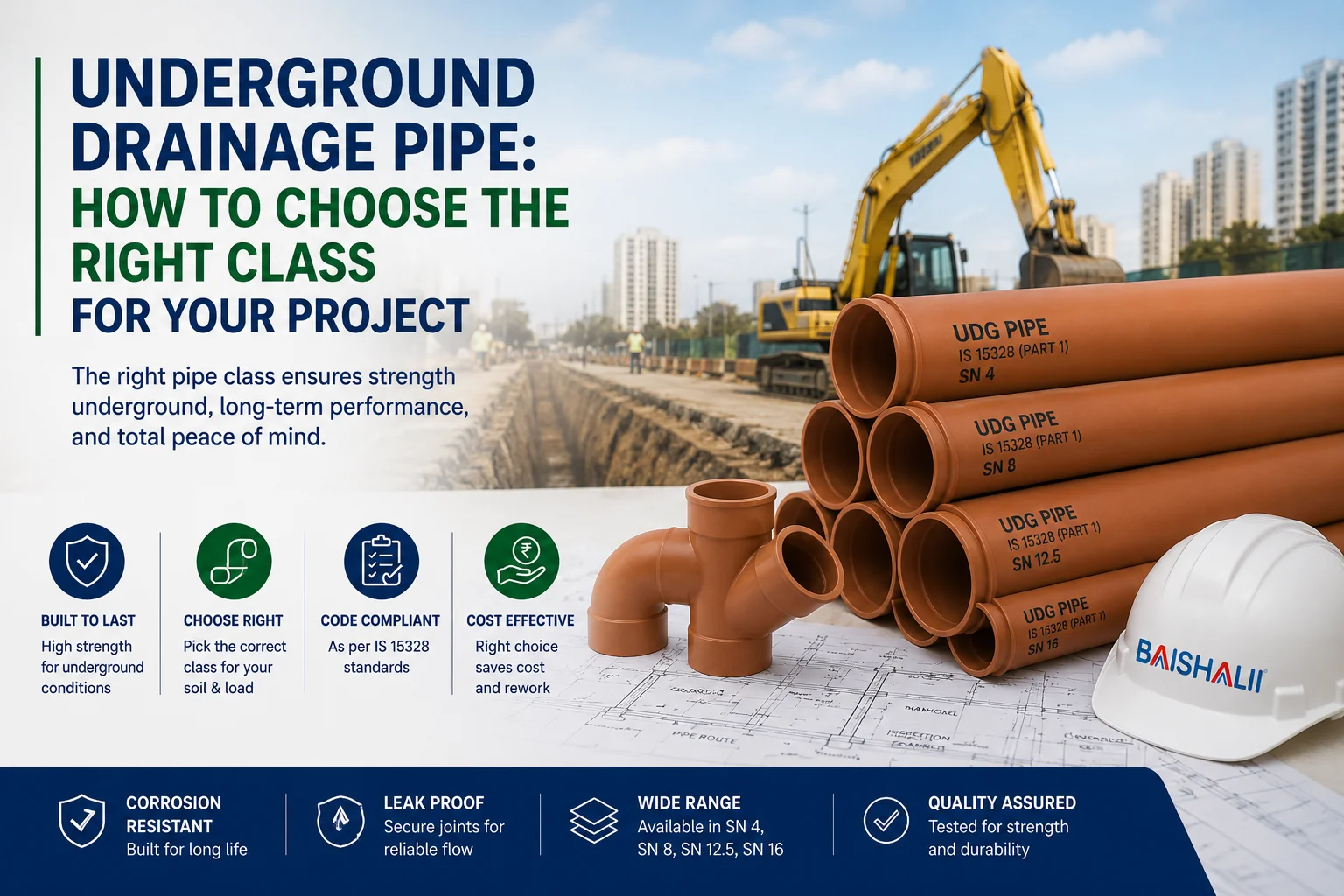
Choosing the Right Class for the Job
One of the most common specification mistakes on underground drainage is treating all buried pipe as interchangeable. It isn't. The right class depends on burial depth, soil type, and whether the line runs under vehicular traffic:
- SN2 (SDR 51) — lighter-duty gravity lines, shallow burial, minimal surface loading
- SN4 (SDR 41) — the commonly specified mid-range class for general residential and commercial underground drainage
- SN8 (SDR 34) — heavier ring stiffness for deeper burial, poor soil conditions, or lines running under driveways and light traffic
Specifying by pipe size alone and skipping the SN/SDR class is how underground lines end up deforming or cracking under load years after installation — well after the site has been backfilled and the warranty conversation has moved on.
A Joint Designed for What You Can't Inspect Later
Once a drainage line is buried, you don't get to walk the joints again. BAISHALII Terraflow pipes are designed with a dual-jointing system — an integrated socket end fitted for an elastomeric sealing ring, with the plain end suited to solvent cement jointing where needed. That combination gives site teams flexibility: rubber-ring joints for faster, gasket-sealed assembly on long runs, and solvent welding where a permanent, fully rigid joint is preferred — without switching pipe systems mid-installation.
Where It's Used
- Soil and waste discharge lines — domestic sewage routed below slab or below grade
- Storm water drainage — surface and roof water collection routed underground
- Industrial effluent lines — where the application allows non-pressure PVC-U discharge
- Retrofits replacing concrete, cast iron, or asbestos-cement drainage — lighter, corrosion-resistant, and considerably easier to handle and align on site
Why PVC-U over legacy materials
Concrete and cast-iron underground drainage have been the default for decades in West Bengal, largely out of habit rather than performance. PVC-U UGD/UDS pipe addresses the two failure points that plague those legacy materials underground: corrosion from soil chemicals and groundwater, and joint failure from rigid, non-gasketed connections that can't accommodate minor ground movement. A properly classed and jointed PVC-U line is lighter to transport and lay, resists the chemical and biological attack that degrades concrete and metal over time, and — with rubber-ring jointing — tolerates the small amount of settlement every buried line eventually experiences.
The Bottom Line
Underground drainage is the one part of a building nobody sees again after handover — which is exactly why it can't be an afterthought on the order sheet. Specifying pipe by IS 15328 class, not just by diameter, and choosing a jointing system suited to the run, is the difference between a drainage line you forget about and one you're digging up in five years.
Working on a Project?
Our team can help with UGD/UDS class selection, quantity estimation, and bulk supply planning for underground drainage on projects of any size.
Have a project in mind?
Talk to our team about pipes, tanks and fittings for your requirement.
Get in Touch