
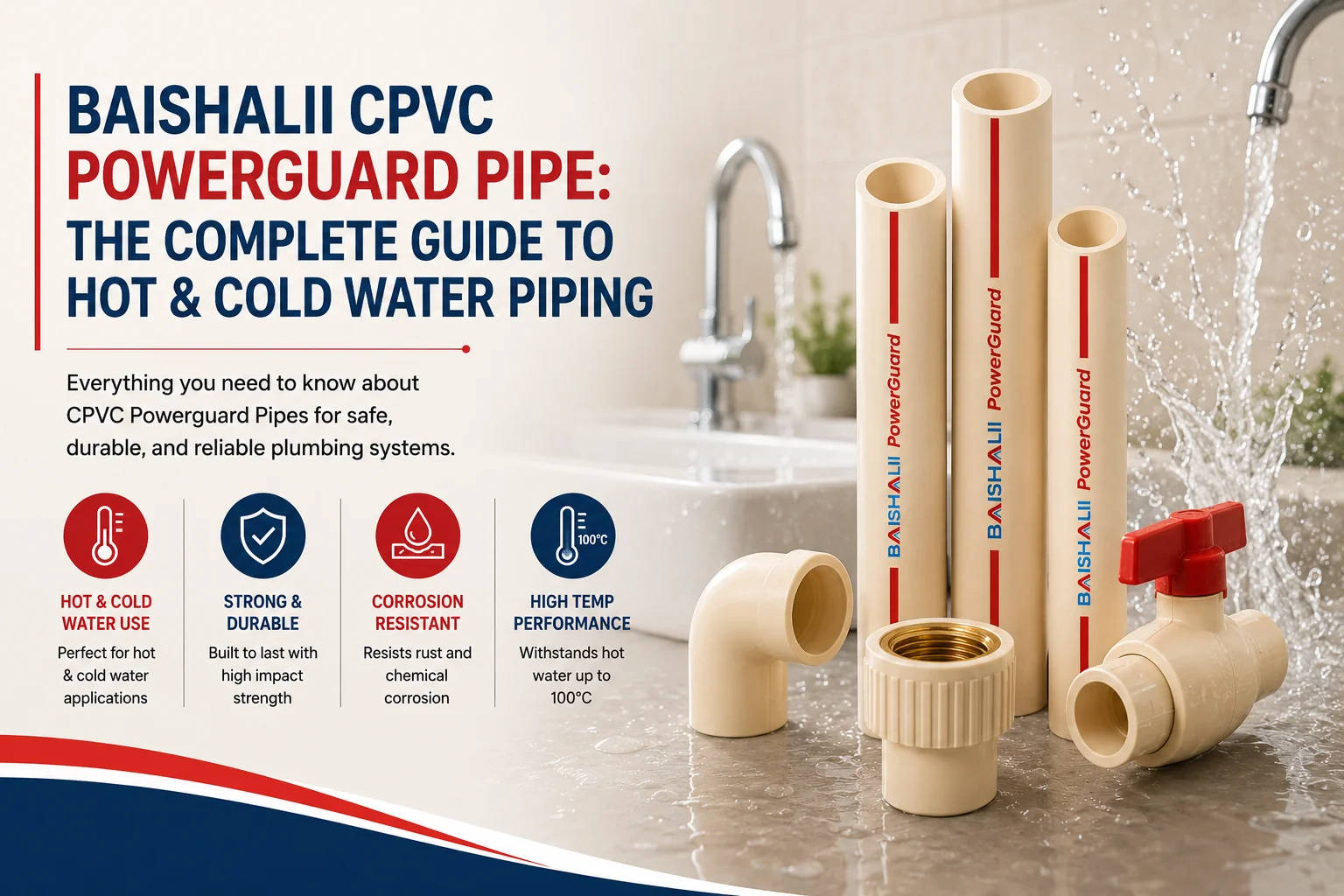
CPVC Pipes for Hot & Cold Water Plumbing: The Complete Guide
CPVC (Chlorinated Polyvinyl Chloride) pipes manufactured to IS 15778:2007 are used for hot and cold potable water distribution, rated to withstand continuous water temperatures up to 82°C and pressures up to 100 psi (SDR 11 / Class 1) — making them a corrosion-free, non-scaling alternative to GI and copper piping for both residential and commercial plumbing.
If you're building or renovating a home, choosing the right pipe for hot water lines is one of those decisions that's easy to get wrong and expensive to fix later. This guide breaks down what CPVC actually is, what the Indian Standard requires, and how to pick the right size and class for your project.
What Is CPVC and Why Does Hot Water Need a Special Pipe?
CPVC is PVC resin that has undergone an additional chlorination process. This raises its softening temperature and improves its resistance to heat and chemical attack, without giving up the low cost, light weight, and corrosion resistance that make PVC popular in the first place.
Ordinary uPVC pipes (the kind used for cold water and drainage) are only rated for continuous use up to around 45°C. Push hot water through them and the pipe softens, sags, and eventually fails. CPVC solves this by handling continuous water temperatures up to 82°C, which covers virtually every domestic and commercial hot water application — geysers, solar water heaters, and centralised hot water systems included.
What IS 15778 Actually Requires
CPVC pipes for potable hot and cold water in India are governed by IS 15778:2007, the Bureau of Indian Standards specification. This standard covers raw material composition, dimensional tolerances, hydrostatic pressure testing, and marking requirements.
Key compliance points
- ISI marking: Compliant pipe carries the IS 15778 designation, size, SDR/pressure class, and BIS licence details, printed at regular intervals along the length.
- Hydrostatic pressure testing: Pipes are tested for sustained pressure at both 27°C and 82°C to confirm long-term performance under real hot-water operating conditions.
- Potable water safety: The compound used must be suitable for contact with drinking water, with controlled limits on lead, cadmium, and other extractables.
- Thermal stability: Each production batch is checked for resistance to degradation under sustained heat exposure, which is what actually determines a CPVC pipe's real-world service life.
Pressure Classes: Which One Do You Need?
IS 15778 defines CPVC pipes by SDR (Standard Dimension Ratio), which determines wall thickness relative to outer diameter — and therefore the pressure rating.
| Class | SDR | Working Pressure @ 27°C | Working Pressure @ 82°C | Typical Use |
|---|---|---|---|---|
| Class 1 | SDR 11 | ~27.6 kg/cm² | ~6.8 kg/cm² | High-rise buildings, commercial risers, higher-pressure lines |
| Class 2 | SDR 13.5 | Lower than SDR 11 | Lower than SDR 11 | Standard residential hot & cold water plumbing |
In practice: for most independent homes and apartments in West Bengal, Class 2 (SDR 13.5) covers standard geyser and kitchen hot-water lines comfortably. Class 1 (SDR 11) is the safer choice for multi-storey buildings, longer risers, or anywhere line pressure runs higher than typical — for example, ground-floor risers feeding upper floors in a G+4 or taller structure.
CPVC vs. Other Pipe Materials for Hot Water
| Parameter | CPVC | GI (Galvanised Iron) | PPR |
|---|---|---|---|
| Corrosion | None — chemically inert | Rusts internally over time, restricts flow | None |
| Scaling | Smooth bore stays scale-free | Heavy scaling reduces effective diameter | Minimal |
| Max. service temp. | 82°C continuous | High, but corrosion is the limiting factor | ~70–95°C depending on grade |
| Jointing | Solvent cement (fast, no threading) | Threaded (labour-intensive, leak-prone at joints) | Heat fusion (needs special tooling) |
| Weight | Light | Heavy | Light |
| Cost | Moderate | Higher installed cost due to labour & fittings | Moderate to high (tooling cost) |
| Common failure mode | UV degradation if left exposed outdoors long-term | Rust, pinhole leaks, reduced flow | Fitting misalignment during fusion |
CPVC's main practical edge over GI is installation speed and long-term flow performance — no threading, no rusting, no gradual narrowing of the bore. Its edge over PPR is that CPVC joints are solvent-welded rather than heat-fused, so no specialised fusion tooling is needed on site, which keeps installation simpler and more forgiving for local plumbers.
Installation Basics: Getting Solvent Welding Right
CPVC pipe failures are rarely about the pipe material itself — they're almost always about poor jointing. A few non-negotiables:
- Cut square. Use a proper pipe cutter, not a hacksaw at an angle. An uneven cut weakens the joint.
- Deburr and clean. Remove burrs from the cut edge and wipe both the pipe end and fitting socket clean of dust before applying cement.
- Use CPVC-specific solvent cement. PVC cement is not a substitute — it won't bond CPVC surfaces properly.
- Apply cement to both surfaces, insert with a quarter-turn twist, and hold for the manufacturer-specified set time before releasing.
- Do not pressure-test immediately. Give solvent-welded joints the full cure time (typically 24 hours, longer in humid or cold conditions) before pressurising the line.
Frequently Asked Questions
Q: Can CPVC pipes be used for both hot and cold water lines? Yes. CPVC is approved under IS 15778 for both hot and cold potable water distribution, so the same pipe class can run both lines in a plumbing layout.
Q: What is the maximum water temperature CPVC pipes can handle? CPVC pipes manufactured to IS 15778 are rated for continuous service up to 82°C, which comfortably covers geyser and typical hot water system temperatures.
Q: Is CPVC pipe safe for drinking water? Yes. Pipes manufactured to IS 15778 use compounds tested and controlled for contact with potable water, with limits on extractable substances like lead and cadmium.
Q: Do CPVC pipes need UV protection if run outdoors? Extended, unshielded outdoor exposure over years can degrade CPVC through UV exposure. For any outdoor or exposed runs, insulation, painting, or conduit protection is recommended, especially in high-UV regions.
Q: Can CPVC and uPVC pipes be joined together? No. CPVC and uPVC use different solvent cements and have different thermal properties. Where a transition is needed, use a proper threaded or flanged transition fitting rather than direct solvent welding.
Q: How do I identify the right pipe class for my building? For standard low-rise residential use, SDR 13.5 (Class 2) is generally sufficient. For high-rise buildings, higher-pressure risers, or commercial installations, SDR 11 (Class 1) is recommended. When in doubt, check with a plumbing consultant or your local dealer for guidance based on your building's height and pressure requirements.
Have a project in mind?
Talk to our team about pipes, tanks and fittings for your requirement.
Get in Touch