
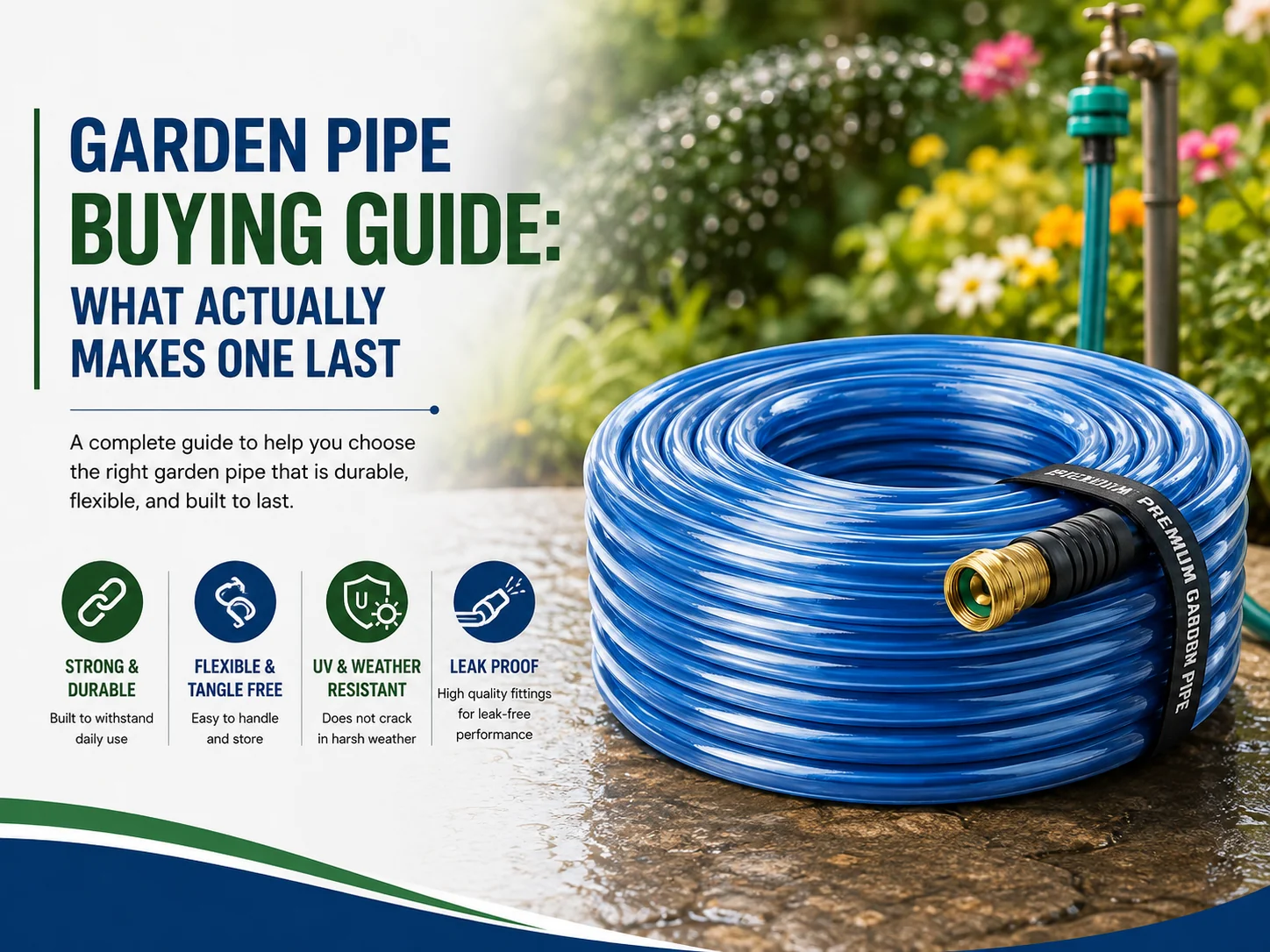
A garden pipe feels like the simplest purchase on the list — until the one you bought in April is stiff, cracked, and leaking at the tap by the time the monsoon arrives. Most garden pipes don't fail because of bad luck; they fail because of a handful of specifications that get overlooked at the point of purchase. Here's what actually determines how long a garden pipe lasts, and how to choose the right one for your home, nursery, or farm.
What's Actually Inside a Garden Pipe
Garden pipes are made from a flexible, or "soft," PVC compound — a different formulation from the rigid PVC used in household plumbing. Two things about that compound decide most of the pipe's working life.
Virgin vs reprocessed PVC. Pipe made from virgin (fresh) PVC resin holds its flexibility, colour, and strength for years. Pipe made with a high share of reprocessed or regrind material — offcuts and scrap re-melted back into the mix — starts out looking identical but stiffens, discolours, and cracks noticeably faster, especially under direct sun. This is the single biggest reason two pipes that look the same in the shop perform so differently after a season outdoors.
Single-layer vs braided (reinforced) construction. A basic garden pipe is a single extruded tube. A braided pipe has a layer of woven polyester thread sandwiched between two layers of PVC, giving it a higher burst pressure and better resistance to splitting at folds. If the pipe will run off a motorised pump or see daily heavy use — washing vehicles, hosing down floors — braided construction is worth the extra cost. For light, gravity-fed tap watering, a good-quality single-layer pipe is usually enough.
The Standard Behind Flexible PVC Pipes
In India, flexible PVC pipes and polymer-reinforced thermoplastic hoses are covered under IS 15265:2003 (amended in 2009), a Bureau of Indian Standards specification originally framed around suction and delivery lines for agricultural pumps. Even though most garden hoses sold for home watering don't fall precisely within that original scope, the wall-thickness, pressure, and ageing requirements it sets are the benchmark the wider industry works to when building flexible PVC hose for outdoor use. Not every garden pipe on the market carries an ISI mark, so where long-term reliability matters — nursery or farm use, for instance — buying from a manufacturer that certifies its broader pipe range is a reasonable way to filter for quality.
What to Check Before You Buy
Diameter. ½ inch (12 mm) suits light watering off a domestic tap; ¾ inch (19 mm) is the standard all-purpose size for most homes; 1 inch (25 mm) is for higher-flow needs like a larger lawn, nursery, or farm connection. Match the diameter to your tap or pump outlet first — buying a size you like the look of and then hunting for reducers and adapters is how most joint leaks start.
Length. Buy for the distance you'll actually cover, not "a bit extra just in case." An oversized pipe gets dragged, coiled, and uncoiled more than it needs to be, and that repeated handling is what causes most kinks and surface cracking. Two shorter pipes joined with a connector are often more practical than one long one.
Wall thickness and construction. Thicker walls and braided reinforcement cost more but resist kinking and flattening at bends far better than a thin, single-layer pipe. If a pipe folds flat and stays flat under light hand pressure, it will do the same thing — and stop your water flow — the first time it gets stepped on or coiled tightly.
UV stabilisation. This matters more in Indian conditions than almost anywhere else. Pipe without UV stabilisers left out in the sun for a season typically turns brittle at the surface and starts hairline-cracking; UV-stabilised compound holds its flexibility and colour for years longer under the same exposure.
Working pressure and temperature. Check the rated pressure if you're connecting to a pump rather than gravity flow from an overhead tank. And never run hot water through a standard garden pipe — PVC softens and deforms well below boiling point, so this only works with a pipe specifically rated for it.
Fittings. Threaded male/female ends work well if you're connecting directly to a tap or nozzle. Quick-connect couplers are worth it if you switch between a nozzle, sprinkler, and hose reel often, since they avoid repeated wear on a threaded joint.
Where Most Garden Pipes Actually Fail
It's rarely the middle of the pipe. The two weak points are almost always the same:
- The threaded joint at the tap — a worn or over-tightened washer here causes more leaks than any fault in the pipe body.
- A repeated fold point — coiling a pipe the same way every time creates a crease that eventually becomes a permanent weak spot, and then a split.
Buying on price-per-metre alone, without checking wall thickness or construction, is the most common mistake. The thinnest pipe at a given length looks like the better deal until it splits at a fold within weeks of daily use.
Getting More Life Out of the One You Buy
- Drain the pipe and coil it loosely after use, rather than leaving it stretched out in the sun with water still inside — trapped, heated water accelerates internal wear.
- Store it out of direct sunlight when not in use, even if it's UV-stabilised; some shade always adds life.
- Lift the pipe over rough edges — boundary walls, gravel, broken paving — instead of dragging it. Abrasion is a leading cause of slow, hard-to-spot leaks.
- Before long storage (over winter or during the monsoon), rinse the coil to prevent algae or fungus building up on the surface, particularly with transparent or milky-white pipes.
In Short
A garden pipe is a small purchase, but the gap between one that lasts a single season and one that lasts several years comes down to a short list of checkable things: the PVC used, whether it's braided, UV stabilisation, and matching diameter and length to what you'll actually use it for. Check those before price, and the rest tends to take care of itself.
BAISHALII's PVC Garden Pipes are built UV-stabilised and kink-resistant for everyday watering and washing across Indian outdoor conditions.
Have a project in mind?
Talk to our team about pipes, tanks and fittings for your requirement.
Get in Touch