
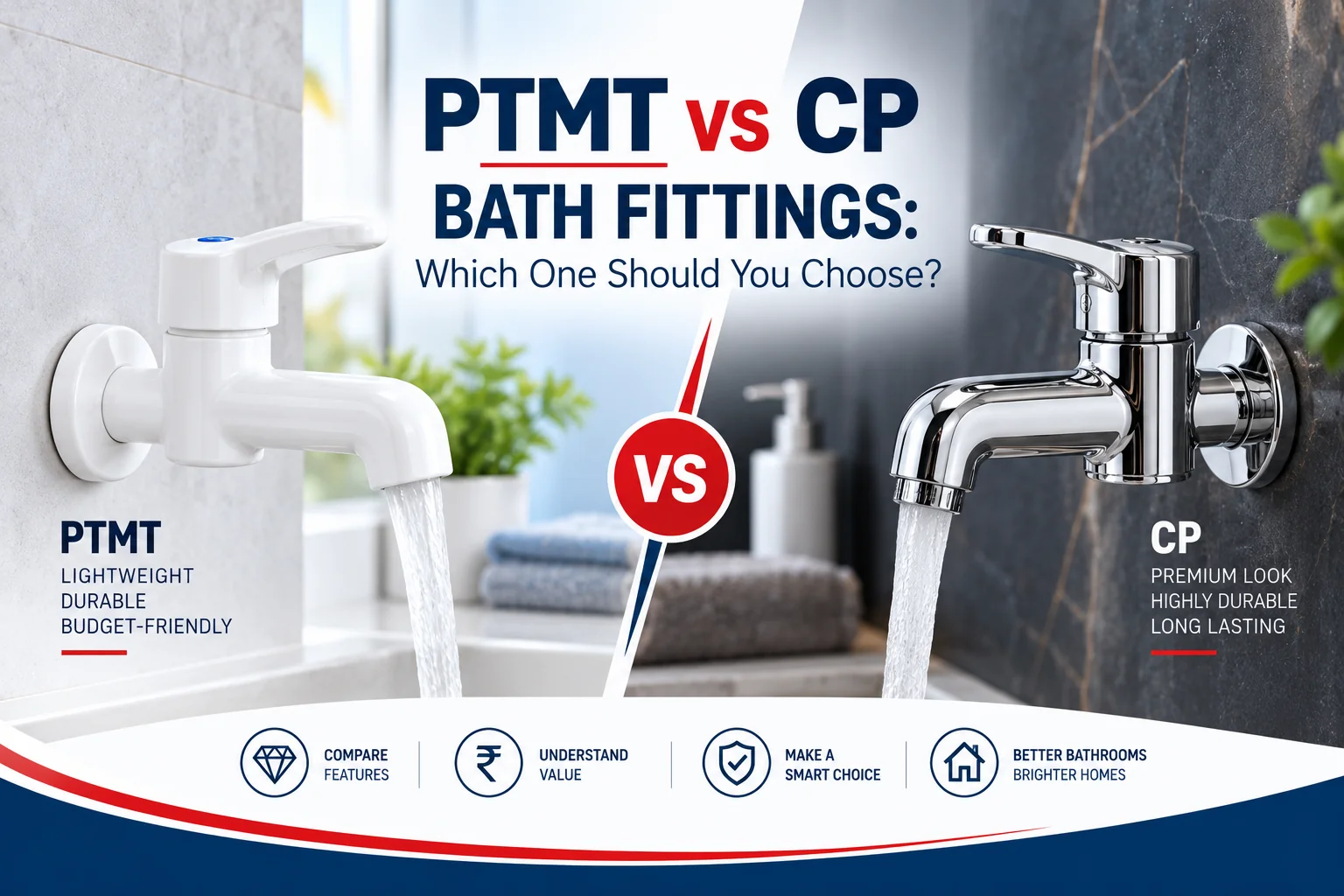
PTMT vs CP Bath Fittings: Which One Should You Choose?
When choosing bathroom fittings, most buyers focus on design, finish, and price. But one of the most important decisions is the material of the fitting. In the Indian market, two popular choices are PTMT (Poly Tetra Methylene Terephthalate) fittings and CP (Chrome-Plated) brass fittings.
Both have their advantages, but they are designed to meet different requirements. While CP fittings are traditionally preferred for their premium appearance and robust construction, PTMT fittings offer excellent resistance to corrosion, affordability, and practical performance—particularly in areas where water quality is a concern.
So, PTMT vs CP bath fittings—which is better?
The answer depends on your budget, water conditions, bathroom usage, and expectations from the product.
What Are PTMT Bath Fittings?
PTMT stands for Poly Tetra Methylene Terephthalate, an engineering thermoplastic used to manufacture bathroom and plumbing fittings.
PTMT fittings are generally manufactured through injection moulding and are available in a variety of colours and finishes. They are lightweight, corrosion-resistant, and do not develop the typical surface corrosion associated with metal fittings.
Common PTMT products include:
- Bib cocks
- Pillar cocks
- Angle cocks
- Stop cocks
- Health faucets
- Shower accessories
- Bathroom accessories
One of the biggest advantages of PTMT is its resistance to corrosion, making it particularly useful in regions where water contains higher levels of dissolved salts or has corrosive characteristics.
What Are CP Bath Fittings?
CP generally refers to chrome-plated brass fittings, where a brass body is finished with a layer of chrome plating.
Brass provides a strong and durable base, while chrome plating gives the fitting its characteristic bright, polished appearance.
CP fittings are widely used in:
- Residential bathrooms
- Hotels
- Commercial buildings
- Premium homes
- Offices
- Institutional projects
Their combination of metal construction, strength, and attractive chrome finish has made CP fittings a long-standing choice in the bathroom industry.
PTMT vs CP Bath Fittings: Key Differences
| Feature | PTMT Bath Fittings | CP Brass Bath Fittings |
|---|---|---|
| Material | Engineering thermoplastic | Brass with chrome plating |
| Corrosion resistance | Excellent | Good, but depends on plating quality |
| Weight | Lightweight | Heavier |
| Appearance | Modern, practical finishes | Premium chrome appearance |
| Maintenance | Low | Requires cleaning to maintain shine |
| Price | Generally more economical | Generally more expensive |
| Strength | Good for normal bathroom applications | Excellent mechanical strength |
| Water-quality tolerance | Excellent against corrosion | Depends on material and plating quality |
| Installation | Easy due to lightweight construction | Relatively heavier |
| Typical application | Residential and utility bathrooms | Residential, premium and commercial |
1. Material and Construction
The most fundamental difference is the material.
PTMT fittings are made from an engineering-grade thermoplastic, while CP fittings generally use brass as the base material with a chrome-plated surface.
Because PTMT is a polymer, it does not rust or corrode in the same way metal fittings can. CP brass fittings, on the other hand, depend on the quality of the brass and the chrome-plating process for long-term surface performance.
2. Corrosion Resistance
This is one area where PTMT has a significant advantage.
Bathrooms are constantly exposed to water and moisture. In addition, water quality varies considerably across India.
Hard water, dissolved salts, and certain chemical characteristics of water can affect metal surfaces over time.
PTMT is inherently resistant to corrosion, making it a practical choice for locations where water quality is a concern.
CP fittings can also offer excellent durability, but their long-term appearance depends significantly on the quality of the underlying brass and chrome plating.
3. Appearance
If appearance is the primary consideration, CP fittings have traditionally held the advantage.
The bright, reflective chrome surface gives a bathroom a sophisticated and premium appearance. This is one reason CP fittings remain extremely popular in modern residential and hospitality projects.
PTMT fittings are available in attractive designs and finishes, but their appearance is generally more functional than the highly reflective chrome look associated with CP brass fittings.
Choose CP when: premium chrome aesthetics are a priority.
Choose PTMT when: functionality, corrosion resistance, and value are more important.
4. Durability and Strength
CP brass fittings are made from metal and generally provide excellent mechanical strength. They are well suited for applications where a robust metal fitting is preferred.
PTMT fittings are lightweight but can still provide reliable performance when manufactured using quality engineering-grade material and properly designed components.
However, buyers should not judge durability solely by whether a fitting is metal or plastic. Material grade, manufacturing quality, design, valves/cartridges, seals, and quality control all influence product life.
5. Weight
PTMT fittings are considerably lighter than brass fittings.
This makes them easy to handle, transport, and install. The lower weight can also be advantageous for certain applications where reducing the load on plumbing components is desirable.
CP brass fittings have a heavier and more substantial feel, which many consumers associate with premium quality.
6. Maintenance
Both types of fittings require basic cleaning, but their maintenance characteristics differ.
Chrome-plated fittings can develop water spots, scale deposits, or loss of shine if they are exposed to hard water and not cleaned regularly.
PTMT fittings do not depend on a chrome layer for their appearance and are highly resistant to corrosion.
For households dealing with hard water, PTMT can therefore be a particularly convenient option.
PTMT or CP: Which Is Better for Hard Water?
If your home receives hard water, PTMT fittings deserve serious consideration.
Hard water can leave mineral deposits on bathroom fittings. Over time, these deposits can affect the appearance and, depending on the fitting and water chemistry, contribute to deterioration of metal surfaces.
PTMT's inherent corrosion resistance makes it well suited to such environments.
However, hard water can affect other components of a bathroom system too, including aerators, cartridges, showerheads, and plumbing connections. Therefore, choosing a corrosion-resistant fitting is only one part of managing hard-water problems.
Which One Is More Affordable?
In general, PTMT fittings are positioned as a more economical alternative to many CP brass fittings.
The lower material weight and manufacturing characteristics of PTMT can make it attractive for budget-conscious residential projects.
CP brass fittings typically command a higher price because of their brass construction, machining, finishing, chrome plating, and premium appearance.
For a complete bathroom renovation or a project involving multiple fittings, the difference can become significant.
Is PTMT Less Durable Because It Is Plastic?
This is a common misconception.
The word “plastic” often makes consumers think of low-quality products. But PTMT is an engineering thermoplastic, not the same as ordinary low-grade plastic used for inexpensive household products.
The performance of a PTMT fitting depends on:
- Quality of the raw material
- Material formulation
- Product design
- Wall thickness
- Valve mechanism
- Sealing components
- Manufacturing precision
- Quality-control processes
- Installation
Therefore, a good-quality PTMT fitting can be a reliable long-term bathroom product.
At the same time, not every PTMT fitting is automatically superior to every brass fitting. Brand quality and product construction matter.
PTMT vs CP: Which Should You Choose?
The right choice depends on what matters most to you.
Choose PTMT if you want:
- Excellent corrosion resistance
- A cost-effective solution
- Lightweight fittings
- Low-maintenance operation
- Better suitability for challenging water conditions
- Practical fittings for everyday residential use
Choose CP Brass if you want:
- Premium chrome aesthetics
- A traditional metal fitting
- Greater mechanical robustness
- A heavier, premium feel
- A classic choice for luxury and commercial bathrooms
What About Hotels and Commercial Projects?
Commercial projects often have different priorities from residential bathrooms.
Hotels, restaurants, offices, hospitals, and other institutions may prioritise:
- Appearance
- Frequent usage
- Mechanical strength
- Ease of maintenance
- Replacement cost
- Long-term operating cost
- Water conditions
CP brass remains a popular choice for premium commercial applications because of its appearance and robust construction.
However, PTMT can be an attractive option for large-scale projects where corrosion resistance, affordability, and ease of replacement are important.
The choice should be based on the specific application rather than simply assuming that metal is always better.
Don't Choose Only by Appearance
A bathroom fitting is a functional plumbing component—not merely a decorative product.
Before buying, consider:
1. Water quality: Is your water hard or corrosive?
2. Usage: Is it for a family bathroom, rental property, hotel, or commercial facility?
3. Budget: What is the total cost of all the fittings?
4. Maintenance: How much cleaning and upkeep are you willing to do?
5. Construction quality: What material grade and manufacturing standards does the manufacturer follow?
6. Warranty and after-sales support: Is replacement or service easily available?
7. Internal mechanism: The body material is important, but so are cartridges, valves, washers, seals, and other internal components.
The Bottom Line
There is no universal winner in the PTMT vs CP bath fittings debate.
PTMT fittings offer a compelling combination of corrosion resistance, lightweight construction, affordability, and low maintenance. They can be particularly suitable for homes and projects where water quality and value for money are important.
CP brass fittings, meanwhile, continue to be preferred when premium chrome aesthetics, metal construction, and robust mechanical performance are the main priorities.
The smartest approach is to choose based on application, water quality, product quality, and budget—not simply on whether the fitting is plastic or metal.
Quick Verdict
For value + corrosion resistance: PTMT
For premium chrome appearance: CP Brass
For hard-water environments: PTMT can be a strong choice
For premium bathrooms: CP Brass
For budget-conscious projects: PTMT
For heavy-duty metal construction: CP Brass
Ultimately, a good-quality fitting from a reliable manufacturer will usually deliver better results than choosing solely on material type. Always check the product specifications, construction quality, warranty, and installation requirements before making your decision.
Frequently Asked Questions
What is the difference between PTMT and CP bath fittings?
PTMT fittings are made from an engineering thermoplastic, while CP fittings generally use a brass body with a chrome-plated finish. Their differences include weight, appearance, corrosion resistance, cost and maintenance.
Are PTMT fittings good for hard water?
Yes. PTMT is inherently resistant to corrosion, making it a practical option in areas where hard or corrosive water can affect metal surfaces.
Are CP fittings better than PTMT fittings?
Not necessarily. CP fittings offer advantages such as a premium chrome appearance and robust metal construction, while PTMT offers excellent corrosion resistance and value. The better choice depends on the application.
Are PTMT bath fittings durable?
Quality PTMT fittings can provide reliable long-term performance. Durability depends on the quality of the material, product design, internal mechanism, manufacturing and installation.
Which is more affordable—PTMT or CP fittings?
PTMT fittings are generally more economical than many CP brass fittings, although prices vary by product, design and manufacturer.
Which bath fitting is better for a budget bathroom?
PTMT can be an excellent choice for budget-conscious bathrooms because of its combination of affordability, corrosion resistance and lightweight construction.
Why are CP fittings so popular?
CP fittings have traditionally been popular because their polished chrome finish gives bathrooms a premium appearance, while brass provides a strong metal base.
Have a project in mind?
Talk to our team about pipes, tanks and fittings for your requirement.
Get in Touch