
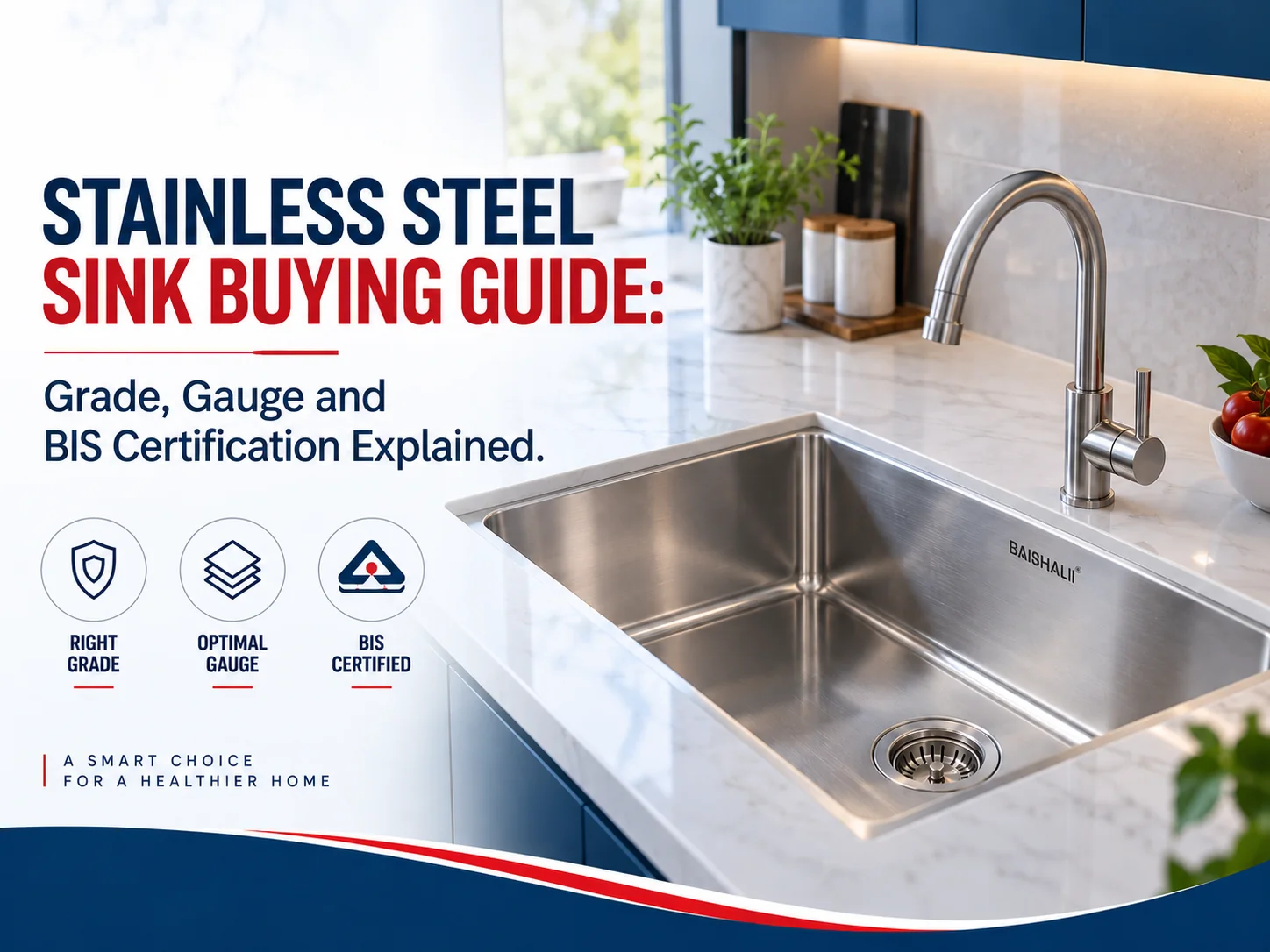
Choosing a kitchen sink may seem simple, but the right stainless steel sink can make a significant difference to your kitchen's durability, hygiene, appearance and everyday convenience.
With so many products claiming to be "premium," "304 grade," "heavy gauge" or "BIS certified," it can be difficult to know what actually matters.
So, how do you choose a good stainless steel kitchen sink?
The answer comes down to four key factors:
Stainless steel grade + sheet thickness + construction & finish + BIS compliance
This guide explains each of them in simple terms so you can make an informed decision.
What Makes a Good Stainless Steel Sink?
A good stainless steel sink should be:
- Resistant to corrosion and staining
- Strong enough for everyday kitchen use
- Rigid and resistant to denting
- Easy to clean and maintain
- Properly finished with smooth, neat edges and corners
- Designed with adequate bowl depth and drainage
- Manufactured using the appropriate stainless steel grade
- Compliant with the applicable Indian Standard, where required
It is important to remember that no single specification determines the quality of a sink.
A sink made from a good grade of stainless steel can still disappoint if it is too thin, poorly formed or badly finished.
1. Understanding Stainless Steel Grades
The stainless steel grade is one of the most important specifications to consider when buying a kitchen sink.
Stainless steel is an alloy containing chromium, which helps form a protective surface layer and provides corrosion resistance. Different grades contain different proportions of elements such as chromium and nickel, giving them different properties.
What is 304 Stainless Steel?
304 stainless steel is a widely used austenitic stainless steel grade known for its good corrosion resistance, durability and suitability for kitchen applications.
It is commonly associated with premium stainless steel kitchen products because it performs well under normal household conditions.
However, there is an important point to remember:
304 grade alone does not make a sink high quality.
The thickness of the sheet, manufacturing process, construction, finish and overall workmanship also matter.
What about 302 stainless steel?
IS 13983:1994 — Stainless Steel Sinks for Domestic Purposes specifies austenitic stainless steel grades including 304 and 302 for sinks covered by the standard.
Therefore, consumers should avoid assuming that a sink is automatically non-compliant simply because its material specification does not use the term "304."
The more important question is:
Does the product conform to the applicable Indian Standard and is it manufactured by a duly licensed manufacturer where BIS certification is mandatory?
2. Gauge vs Thickness: What Does Sink Gauge Mean?
"Gauge" is commonly used by sink manufacturers and sellers to describe the thickness of stainless steel.
You may see terms such as:
- 18 gauge
- 20 gauge
- 22 gauge
- Heavy gauge
- Premium thickness
But gauge can be confusing because gauge numbers are not always presented consistently across different product categories and markets.
For a consumer, the more useful specification is the actual sheet thickness in millimetres (mm).
Why does thickness matter?
A thicker stainless steel sheet generally provides:
- Greater rigidity
- Better resistance to denting
- Less vibration
- A more solid feel
- Better structural stability
However, thicker does not automatically mean better.
A sink's construction, forming process, reinforcement, bowl design and workmanship also affect its performance.
A better way to compare sinks
Instead of asking only:
"What gauge is this sink?"
ask:
"What is the actual stainless steel sheet thickness in millimetres?"
This gives you a more meaningful specification for comparison.
3. What Does BIS Certification Mean for Stainless Steel Sinks?
This is one of the most important points to understand when buying a stainless steel kitchen sink in India.
The applicable Indian Standard for domestic stainless steel sinks is:
IS 13983:1994 — Stainless Steel Sinks for Domestic Purposes
The standard covers important aspects of a sink including:
- Material
- Dimensions and tolerances
- Sheet thickness
- Bowl depth
- Construction and workmanship
- Waste outlet
- Tap holes
- Overflow
- Surface finish
- Marking
BIS documentation for IS 13983 specifically identifies stainless steel sinks for domestic purposes and includes requirements relating to material, thickness, dimensions, construction, workmanship and finish.
Is BIS Certification Mandatory for Stainless Steel Sinks?
Yes, for stainless steel sinks for domestic purposes covered by the applicable Quality Control Order, the BIS Standard Mark is mandatory from the applicable implementation date.
The Bureau of Indian Standards currently lists IS 13983:1994 — Stainless Steel Sinks for Domestic Purposes under products covered by compulsory certification.
The current regulatory framework requires covered products to conform to the relevant Indian Standard and bear the BIS Standard Mark under a BIS licence.
Therefore, consumers should not treat BIS certification merely as a premium feature. For covered domestic stainless steel sinks, it is a regulatory compliance requirement.
4. What Should You Look for on a BIS-Compliant Sink?
When buying a stainless steel sink, don't rely only on claims such as:
- "BIS quality"
- "BIS approved"
- "BIS standard material"
- "As per BIS"
Instead, look for the appropriate BIS Standard Mark and manufacturer/licence details.
The BIS certification system is designed to establish conformity with the applicable Indian Standard through assessment and testing of the product and manufacturing controls.
A useful rule:
Don't just ask whether a sink is "BIS quality." Check whether the manufacturer is appropriately licensed to use the BIS Standard Mark for the relevant product.
5. What Does IS 13983:1994 Actually Cover?
One of the advantages of buying a sink manufactured to the applicable standard is that quality is not determined by a single parameter.
IS 13983:1994 covers several aspects of the sink.
Material
The standard specifies suitable austenitic stainless steel grades, including 304 and 302 designations.
Sheet Thickness
The standard specifies minimum sheet thickness requirements.
For example, IS 13983 specifies a nominal sheet/strip thickness of not less than 1.00 mm before forming, with the thickness at any point after forming not less than 0.75 mm.
This is an important reason why consumers should look beyond marketing terms such as "heavy gauge."
Bowl Depth and Dimensions
The standard also specifies requirements relating to bowl depth, internal dimensions, sink dimensions and tolerances.
Construction and Workmanship
The standard also addresses construction and workmanship, including components such as:
- Drainers
- Waste outlets
- Tap holes
- Overflows
Finish
Surface finish is also covered.
This matters because a well-finished sink is easier to clean, looks better and can provide a more consistent appearance over years of use.
6. Sink Construction Matters More Than You Think
Two sinks may use similar stainless steel but perform very differently.
Construction quality affects:
- Rigidity
- Noise and vibration
- Resistance to deformation
- Drainage
- Installation
- Long-term appearance
Look closely at:
Corners
Corners should be properly formed and finished without sharp or uneven areas.
Edges
The edges should be neat, uniform and properly finished.
Bowl Formation
The bowl should have consistent geometry without visible deformation.
Drainage
The design should allow water to flow efficiently towards the waste outlet.
Waste Outlet
The outlet should be properly formed and compatible with the drainage system.
7. Bowl Depth: Why It Matters
A deeper bowl can make everyday kitchen work more convenient.
It provides more space for:
- Washing large utensils
- Cleaning vegetables and fruits
- Soaking vessels
- Handling larger cookware
But extremely deep is not necessarily better.
The ideal depth depends on:
- Kitchen counter height
- User comfort
- Cabinet space below the sink
- Plumbing arrangement
- Type of utensils commonly used
For domestic sinks covered by IS 13983, the standard specifies a minimum bowl depth of 150 mm.
8. Single Bowl vs Double Bowl
The right configuration depends on how you use your kitchen.
Single Bowl Sink
A single large bowl is useful when you regularly wash:
- Large pots
- Pressure cookers
- Large utensils
- Baking trays
It offers uninterrupted space for larger items.
Double Bowl Sink
A double bowl provides separate washing areas.
It can be useful when you want to:
- Wash and rinse separately
- Soak utensils in one bowl
- Keep washed items separate
Bowl + Drainer
A drainer provides a dedicated area for placing washed utensils or allowing water to drain away.
The best choice depends on your kitchen layout and daily cooking habits.
9. Sink Finish: Matt, Satin or Gloss?
The surface finish affects both appearance and maintenance.
A good stainless steel sink should have a uniform and properly finished surface.
Depending on the design, you may find:
- Satin finishes
- Matt finishes
- Brushed finishes
- Gloss finishes
- Textured finishes
A smooth, well-executed finish can make everyday cleaning easier and help maintain the appearance of the sink.
However, remember:
A beautiful finish cannot compensate for poor-quality steel or poor construction.
10. Does a Thicker Sink Always Mean a Better Sink?
Not necessarily.
A thicker sheet can improve rigidity and resistance to denting, but thickness is only one part of the equation.
Consider these factors together:
| Factor | Why It Matters |
|---|---|
| Stainless steel grade | Material properties and corrosion resistance |
| Sheet thickness | Rigidity and dent resistance |
| Construction | Structural strength and durability |
| Bowl depth | Everyday usability |
| Dimensions | Fit and installation |
| Surface finish | Appearance and maintenance |
| Waste outlet | Drainage performance |
| BIS compliance | Conformity with applicable requirements |
| Manufacturer | Traceability, warranty and support |
The best sink is the one that provides a balanced combination of these factors.
11. How to Choose the Right Stainless Steel Sink
Before buying, use this simple checklist.
1. Check the stainless steel specification
Don't rely only on words such as "premium steel."
Ask what grade of stainless steel is being used.
2. Check actual sheet thickness
Where possible, look for the thickness in millimetres, rather than relying only on gauge terminology.
3. Check BIS compliance
For domestic stainless steel sinks covered by the applicable requirements, look for the BIS Standard Mark and relevant manufacturer/licence details.
4. Check dimensions
Make sure the sink fits your countertop cut-out and cabinet.
5. Check bowl depth
Choose a depth suitable for your cooking and washing requirements.
6. Inspect the construction
Look at the corners, edges, bowl formation, drain area and overall workmanship.
7. Check the finish
The surface should be uniform and properly finished.
8. Check accessories
Check the quality and compatibility of:
- Waste coupling
- Strainer
- Overflow components
- Drain fittings
- Other supplied accessories
9. Consider after-sales support
A good manufacturer should provide clear product information, warranty terms and customer support.
12. Common Mistakes to Avoid
Mistake 1: Buying only by price
The cheapest sink may not provide the best long-term value.
A kitchen sink is used every day, often for many years.
Mistake 2: Assuming "304" means everything is premium
304 is an important material specification, but it doesn't tell you everything about the finished sink.
Thickness, construction, workmanship and finish also matter.
Mistake 3: Comparing only gauge numbers
Gauge can be confusing.
Always try to compare actual thickness in mm.
Mistake 4: Believing every "BIS" claim
Don't rely on vague statements such as "BIS quality."
Look for the appropriate BIS Standard Mark and manufacturer/licence information.
Mistake 5: Ignoring installation requirements
A high-quality sink can still be inconvenient if its dimensions, bowl depth or installation configuration do not suit your kitchen.
13. The Simple Formula for Choosing a Good Sink
When comparing stainless steel sinks, remember:
Grade tells you about the material.
Thickness tells you about the sheet.
Construction tells you about the sink.
BIS compliance tells you about conformity to the applicable Indian Standard.
Looking at all four gives you a much better basis for choosing a sink than relying on any single marketing claim.
Frequently Asked Questions
Is 304 stainless steel good for kitchen sinks?
Yes. 304 is a widely used austenitic stainless steel grade with good corrosion resistance and suitability for kitchen applications. However, the overall quality of a sink also depends on thickness, construction, workmanship and finish.
What is the best thickness for a stainless steel sink?
Thickness should be considered together with construction and design. For sinks covered by IS 13983:1994, the standard specifies minimum thickness requirements, including a nominal sheet/strip thickness of at least 1.00 mm before forming.
Is a lower gauge number always better?
Not necessarily. Gauge terminology can be confusing. Comparing the actual sheet thickness in millimetres is more useful.
Is BIS certification mandatory for stainless steel sinks?
For domestic stainless steel sinks covered by the applicable Quality Control Order, the BIS Standard Mark is mandatory under the relevant certification requirements. IS 13983:1994 is the applicable Indian Standard listed by BIS for stainless steel sinks for domestic purposes.
What is IS 13983:1994?
IS 13983:1994 is the Indian Standard titled "Stainless Steel Sinks for Domestic Purposes." It covers requirements relating to material, dimensions, thickness, construction, workmanship and finish, among other aspects.
Is 304 the only stainless steel grade permitted for domestic sinks?
No. IS 13983:1994 specifies austenitic stainless steel grades including 304 and 302.
Final Thoughts
A stainless steel sink is a long-term investment in your kitchen.
Instead of choosing a sink simply because it says "304," "heavy gauge" or "premium," look at the complete picture.
Check the:
Material → Thickness → Construction → Finish → Dimensions → BIS compliance
A well-made stainless steel sink should combine the right material with appropriate thickness, good workmanship, practical design and compliance with applicable standards.
And when in doubt, remember the simplest rule:
Don't buy a specification. Buy a well-made sink.
Have a project in mind?
Talk to our team about pipes, tanks and fittings for your requirement.
Get in Touch